Telvonic SYSTEMS
What Wi-Fi 7 changes for production test
Most of the IEEE 802.11be feature list is exercised in design validation and certification. Production test has a narrower job: prove that every unit's radios are calibrated and inside limits — quickly, and with results you can trace. Four changes reach the production line.
- 320 MHz channels in the 6 GHz band. Twice the widest Wi-Fi 6E channel. The RF tester, cable assemblies and shield boxes all have to work across 5.925–7.125 GHz at the full bandwidth.
- 4096-QAM (4K-QAM). The top modulation rates need a transmitter EVM of about −38 dB, roughly 3 dB tighter than the −35 dB required for Wi-Fi 6's 1024-QAM. Less margin for the device means less room for error in the test system.
- Multi-link operation (MLO). Devices can use several bands at once. Production normally still calibrates each radio on its own; MLO is confirmed at the functional or throughput stage.
- More radios per box. Tri-band routers with 4×4 MIMO per band have twelve transmit chains, and each one needs calibrating and verifying.
Features such as preamble puncturing and multi-RU are firmware and protocol behaviours. They are usually covered in design verification and interoperability testing, not per unit on the line.
Calibration: more chains, same cycle-time target
Calibration is normally run with the chipset vendor's manufacturing tool. The tool drives the device over Ethernet or a serial port, an RF tester measures each transmission, and the tool writes correction values into the device. The work grows with bands × chains × power levels × channels sampled.
A tri-band 4×4 router has three times as many transmit chains as a dual-band 2×2 design. Left alone, calibration time grows with it. The usual ways to keep the line balanced:
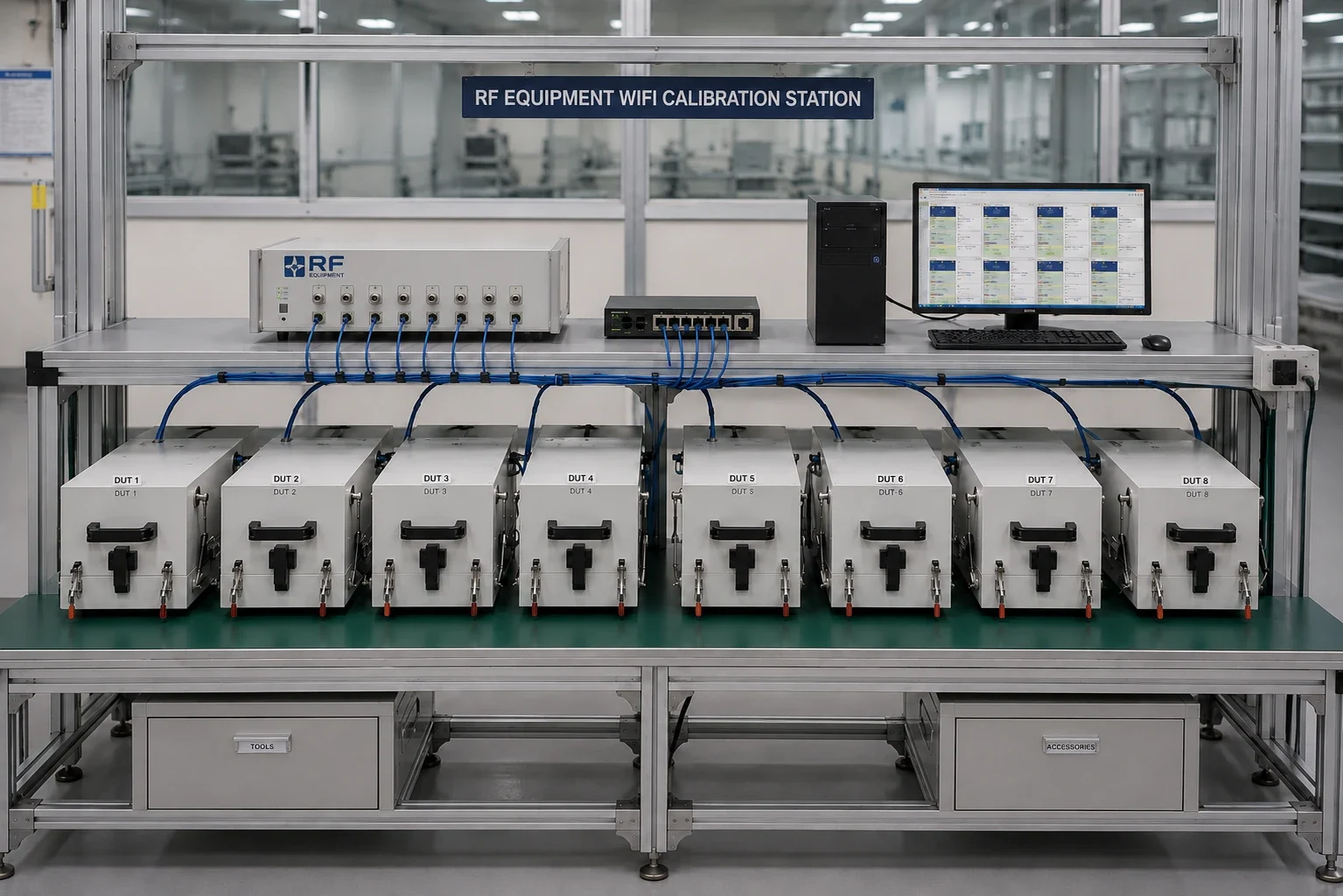
- Test DUTs in parallel. Each device sits in its own shield box; an RF tester is shared through switching or a multi-port tester. Our Wi-Fi calibration station runs eight DUTs this way.
- Split calibration and verification across two stations so neither becomes the bottleneck.
- Sample the channel plan sensibly. Calibrate where the chipset flow requires it, and verify a smaller, representative set of channels.
- Keep path-loss data per port and per frequency, so units don't fail — and get re-tested — because of cable loss rather than the product.
Verification at 6 GHz: EVM, mask and sensitivity
After calibration, every chain is verified against limits: output power, EVM, spectral mask, frequency error and receiver sensitivity (usually packet error rate at a fixed input level).
- Tester EVM floor. The tester's own residual EVM has to sit well below the −38 dB device limit. A tester that is only a few dB better than the limit will fail good units.
- Cable and connector loss. Loss rises at 6–7 GHz, and small changes from wear show up as power errors. Use good cable assemblies, torque connectors correctly and track path loss over time.
- Golden-unit checks. Measuring known-good units at the start of each shift catches drift in cables, attenuators and shield-box gaskets before it turns into false failures.
Which parts of the 6 GHz band a product uses depends on the countries it ships to, so verify the channels your firmware actually enables for each market.
Shield boxes and fixtures for 6 GHz
Shield-box isolation that was fine at 2.4 and 5 GHz can fall off at 6–7 GHz. Ask for isolation figures across the full range up to 7.125 GHz, check that RF feedthroughs and filtered Ethernet and power interfaces are rated for it, and prefer absorber-lined boxes where antenna-coupled measurements are made. Our guide to choosing an RF shield box covers this in detail.
Throughput and functional test
Throughput can be tested conducted (cabled) or over the air in a shielded enclosure. Wi-Fi 7 routers often have 2.5G or 10G Ethernet ports, so the traffic generator and switching must sustain multi-gigabit rates without becoming the limit. Where MLO matters to your customer, confirm it here with a reference client or access point. LEDs, buttons, USB and power are checked at the same stage.
Wi-Fi 7 production line checklist
- RF tester supports 320 MHz bandwidth and frequencies up to 7.125 GHz
- Tester residual EVM comfortably below the −38 dB 4096-QAM limit
- Shield-box isolation verified at 6–7 GHz, not just 2.4 and 5 GHz
- Path-loss data held per port and per frequency, and re-checked on a schedule
- Chipset calibration flow integrated with the test sequencer
- Parallel-DUT plan that meets your units-per-hour target
- Multi-gigabit traffic generation for 2.5G / 10G ports
- Golden units and daily verification
- Every result uploaded to MES by serial number
How Telvonic helps
Our Wi-Fi production test lines are built around an 8-DUT calibration station with shield boxes, an 8-port RF tester and Line Manager software linked to your MES. For a new product you can rent the station for pilot builds, then buy or scale once volumes are proven.