 Telvonic SYSTEMS
Automatic test lines for IoT & RF modules. Tray in, reel out.
Robot cells that download firmware, calibrate and verify every RF path, inspect and pack LGA and LCC modules, with every unit traced in your MES from tray to reel.
The line, in numbers.
 LGA · LCC · M.2
What every module goes through
- Firmware download and RF calibration in a shielded fixture
- RF final and functional test
- Camera inspection, then tape & reel with full traceability
Why this is hard to get right in-house.
Volume and handling
Modules ship in the hundreds of thousands. Loading fixtures by hand caps output and adds handling damage and mix-ups.
Repeatable RF contact
Small LGA modules need the same pogo-pin contact and shielding in every nest, or calibration results drift between fixtures.
Tray-to-reel traceability
Serial or IMEI, firmware version and every calibration and test result must stay linked from the input tray to the output reel.
Station by station.
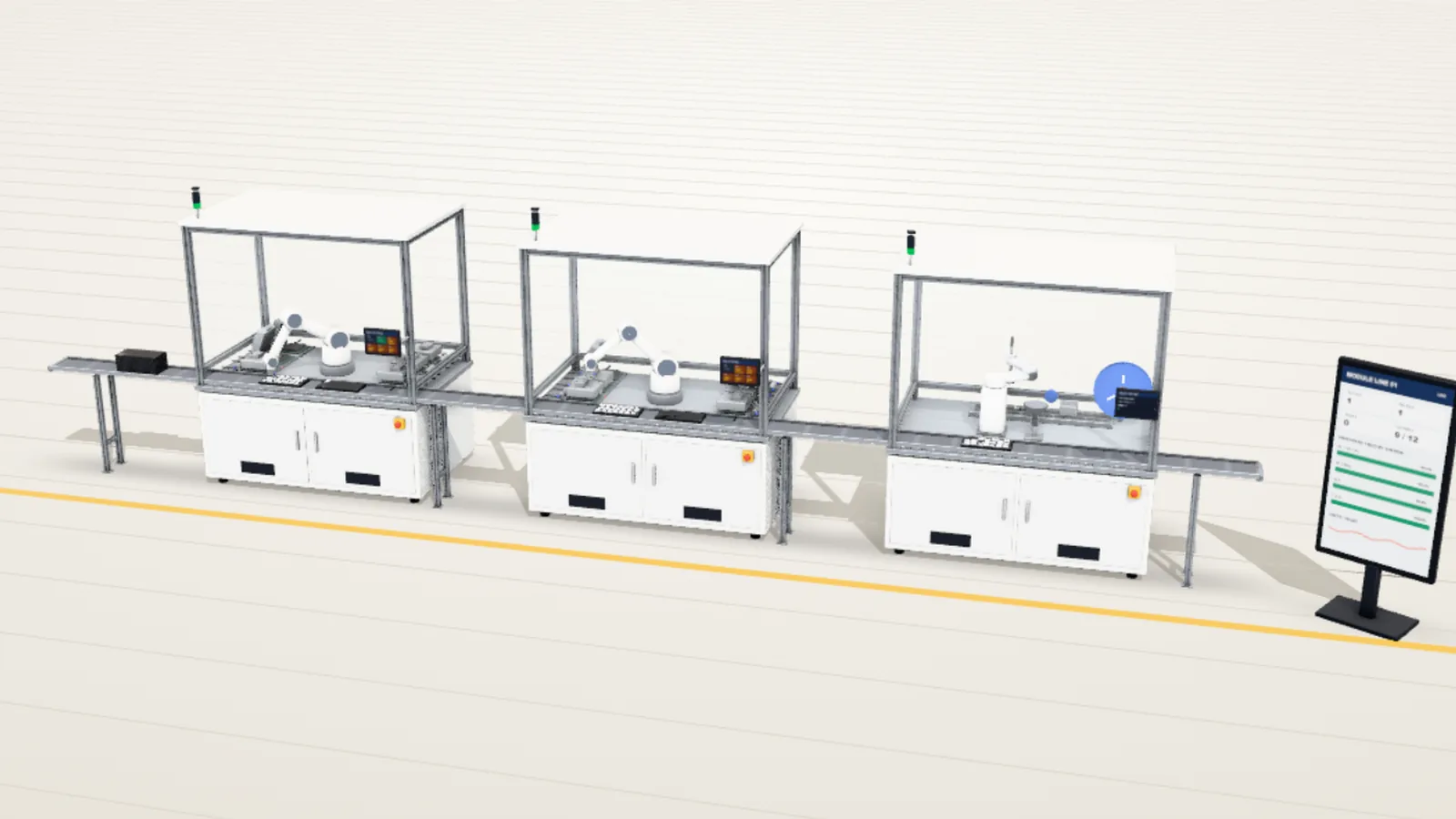
A typical configuration. We split and parallelise stations to hit your units-per-hour target.
Tray loading and ID
JEDEC trays enter on a transfer conveyor; tray and module codes are read and checked against the MES route.
Firmware download and RF calibration
A 6-axis robot loads pneumatic, RF-shielded fixtures; each module is flashed and calibrated in its own nest.
RF final and function test
A second robot cell verifies TX / RX performance and functions such as GNSS, SIM and host interfaces.
Automated optical inspection
An up-looking camera under dome lighting checks pads, marking and labels before packing.
Tape and reel
A SCARA places good modules into carrier tape, which is sealed, wound and labelled; rejects go to a separate tray.
MES and reporting
Every result is uploaded by serial number, with yield, UPH and fixture health on the line dashboard.
Automatic module line
- Module formats
- LGA · LCC · M.2 · Mini PCIe
- Technologies
- LTE Cat-1 / Cat-4 · LTE-M · NB-IoT · 5G RedCap · Wi-Fi / BLE · GNSS · LoRa
- Handling
- 6-axis robots · SCARA · JEDEC trays · tray conveyor
- Fixtures
- Pneumatic, RF-shielded, pogo-pin interface
- Tests
- Firmware download · RF calibration · RF final · functional
- Inspection
- AOI camera with dome lighting
- Output
- Tape & reel with labels · reject tray
- Software
- Line Manager · MES upload by serial

Questions engineers ask us
Can we start with a semi-automatic line?
Yes. Many module lines start with operator-loaded fixtures and add robot cells as volume grows; the fixtures, test software and MES link stay the same.
Which modules can you test?
LGA and LCC modules for LTE, LTE-M, NB-IoT, 5G RedCap, Wi-Fi / BLE, GNSS and LoRa, plus M.2 and Mini PCIe cards. Fixtures are designed for each module footprint.
How is each module traced?
Line Manager records the tray, the module serial or IMEI, the firmware version and every calibration and test result, and uploads them to your MES, from tray to reel.
Planning a module line? Let's size the cells.
Send the module footprint, technologies and target units per hour. We'll propose the fixture count, robot cells and budget.