Telvonic SYSTEMS
What sets your station's output? Find the slowest step.
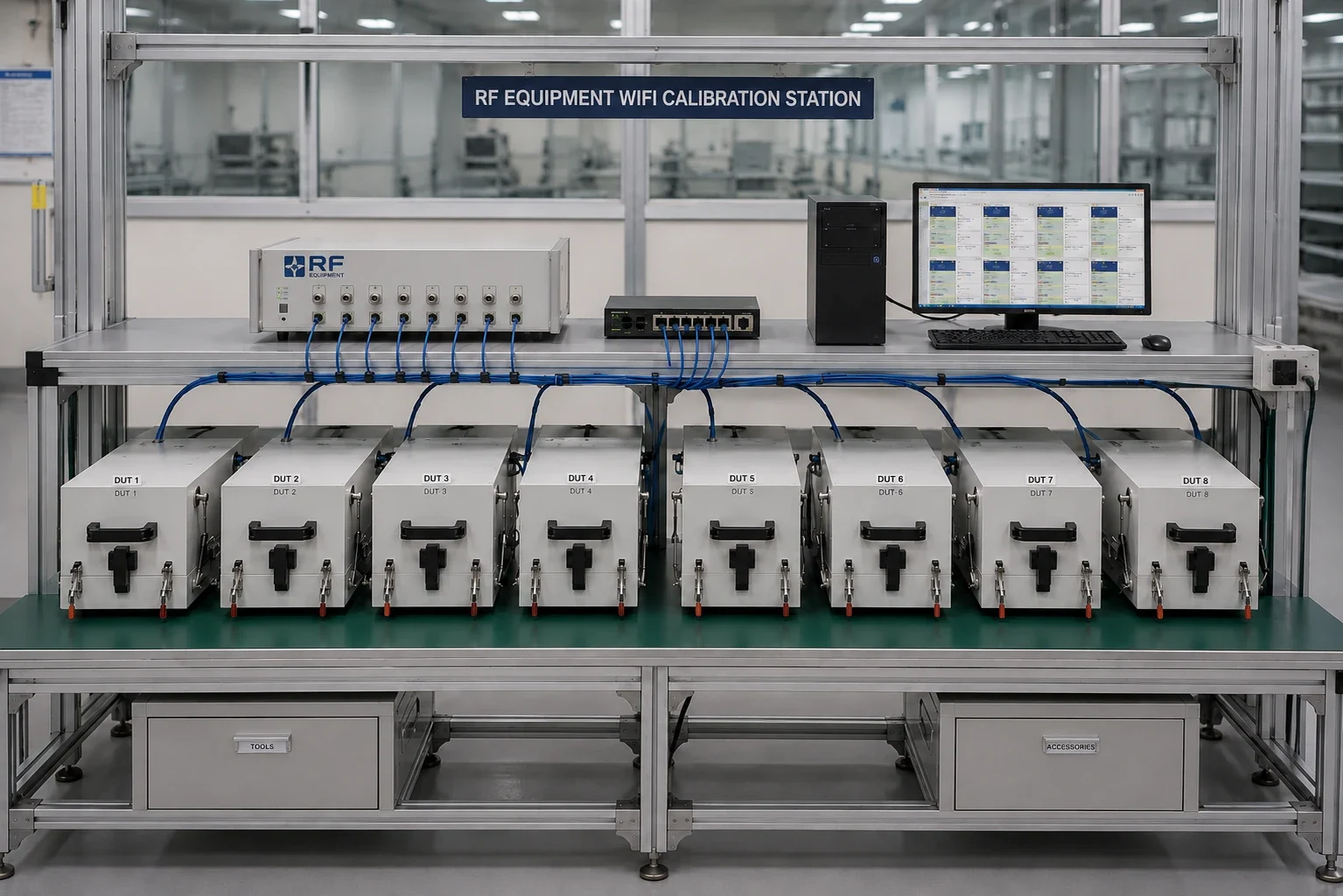
Enter your chipset's RF test time. Eight shield boxes test in parallel, but one robot does every hand-off, one board at a time. The slower of the two sets how often a finished board leaves.
Inputs
The time a board spends in a shield box for your chipset's calibration and test.
Boxes testing in parallel. Our standard Wi-Fi station has 8.
Unload the tested board, fetch a fresh one, load it and close the lid. On our example line this measured 27 s.
Result
What would help
| Change | One every | Per hour | Gain |
|---|
Each row changes one thing and keeps the rest as entered.
The slowest step sets the pace.
A shield box is busy for the test plus its hand-off, so the boxes together finish one board every (test + hand-off) / boxes seconds. The robot can only do one hand-off at a time. The slower of the two is your output. On our line simulation of an 8-box station, measured at 1, 75, 150 and 300 s of test (the hollow dots), the model was within about a second of every point. Real lines also lose time to operator stops, retests and changeovers.
Questions about station throughput
Why doesn't a shorter RF test always give more boards per hour?
Eight shield boxes test in parallel, but one robot unloads and reloads them one board at a time. If the robot's hand-off takes longer than the shield boxes need per board, the robot sets the pace and a shorter test changes nothing until the hand-off gets faster.
What is the hand-off time?
The time the robot needs per board: open the box, take out the tested board, put it on the outfeed, pick a fresh board, load it and close the lid. On our example line it measured 27 seconds. Time your own robot and enter its figure.
When does the RF test become the limit?
When the shield boxes together finish a board more slowly than the robot can serve them. With N boxes and a hand-off of H seconds, that happens above a test time of about (N - 1) x H. For 8 boxes and 27 seconds, that's about 189 seconds.
How accurate is the calculator?
It is a simple model: one board every max(hand-off, (test + hand-off) / boxes) seconds. On our line simulation of an 8-box station it matched every measured point to within about one second. Real lines add operator stops, retests and changeovers, so treat it as a planning figure, not a guarantee.
Need a line for your chipset? We'll size it.
Send your RF test time, band configuration and target volume. We'll work out the stations, shield boxes and handling to hit it.